
Author: Jason Handrinos

AEGINA PRISON

The Aegina Prison was one of the oldest correctional facilities in the country. The building was founded in 1828, to serve as an orphanage for children of the Greek War of Independence, housing at the same time various technical schools and part of the National Printing House. The building, covering an area of approximately 20 acres, changed many uses during the 19th century. During the reign of Bavarian King Otto, it housed the Military Academy and later was converted to a prison, before being abandoned. In 1880, it was rebuilt to serve exclusively as a correctional facility with the official name “Criminal Prisons of Aegina”. The prison accepted large numbers of convicts and, from 1925, political prisoners, members and officials of the Communist Party of Greece. The number of the latter increased in the 1930s after the passing of the infamous anticommunist law. During the same period, the living conditions of the inmates were extremely harsh. Clothing, bedding and medicine were scarce, resulting in many cases of tuberculosis and venereal diseases, while beatings and abuse of prisoners were frequent.

During the Occupation, Aegina Prison continued to operate as a criminal prison. In the autumn of 1941, there were 371 prisoners[1], divided into those held by the Greeks, those held by the Italians and those held by the Germans. The prison was also used by the German forces as an annex of the Central Military Prison of Athens (Kriegswehrmachtgefängnis Athen – Abt. Aegina). The number of prisoners grew in line with the increase in convictions by the Greek courts and arrests by the occupying forces. At the end of September 1942 there were 468 people in prison, of whom 314 had been convicted by Greek courts, 54 by order of the German authorities and 100 by order of the Italian authorities. Onthe 1st of May 1943, there were 250 political prisoners alone, referred to as “destitute” in correspondence from the GRC Prisoners’ Office.[2] In October 1943, as part of the temporary decongestion ordered by the German authorities, 277 prisoners remained in Aegina, 170 of whom had been convicted of crimes committed during the occupation, while there were also 29 deserters from the 1940/41 war.[3] The number then increased again to include those convicted by Greek military courts and Resistance fighters. The prisoners were divided into those held by the Germans (Chapters 1, 2 and 3) and those held by the Greeks (Chapters 4 and 5). Several prisoners were put to forced labour by order of the local German authorities, performing various tasks in requisitioned buildings or on German fortifications in Mesagros (Tourlos) on Aegina, where deaths, executions and escapes took place.[4] 

The Aegina Prison was severely affected by the tragic food situation in the capital during the winter of 1941/42. In a document addressed to the Prison Administration (19 August 1941) the prison doctor himself reports that every day he finds himself “faced with ghosts whose exhaustion due to malnutrition has progressed to such an extent that their appearance before me moves my pity for these living corpses, which the State nevertheless wishes to reform and not lead to death by starvation.”[5] Official documents of the time report that a total of 150 prisoners lost their lives due to malnutrition and hardship, while many died during their transfer to other prisons or hospitals in the capital.[6] On 25 November 1943, a committee of prisoners appealed to the qusiling Prime Minister Ioannis Rallis for emergency assistance from the Ministry of Food, “considering that in the winter of 1941-42, four-fifths of the prisoners here died of starvation.”[7] The Red Cross and its representative at the Aegina Prison, Sister Meropi Petsaggouraki, played an important role in ensuring the regular supply of food (cheese, raisins, olives, bread), clothing, medicines and cigarettes, at a time when the Germans had banned the sending of parcels to political prisoners by regular mail.[8] 

The prison continued to operate without interruption until 1985, when it was closed permanently. During the Civil War, it was one of the most important prisons for political prisoners in the country. A total of 122 prisoners, convicted by criminal courts and courts-martial, were executed between 1946 and 1949. In the post-Civil War period, leading members of the Communist Party of Greece (KKE) were held there, such as Nikos Belogiannis, Stefanos Sarafis, Antonis Abatielos, Charilaos Florakis, Kostas Loules, Leonidas Kyrkos, and Manolis Glezos, while during the dictatorship, Alekos Panagoulis, Lefteris Verivakis, and Stathis Giotas were imprisoned there. In 1996, an initiative by members of the National Resistance prevented the demolition of the building complex. 


[1] GRGSA, Ministry of Food Supply Archive, file 99, Status of State prisons and reformatories, including the number of staff and inmates, n.d. [1941].

[2] DAEES Archive, TB No. 13, GRC Prisoners’ Office to Meropi Petsaggouraki, AP 4553, Athens, 1 May 1943.

[3] GRGSA, Ministry of Justice Archive, f. 174a, Criminal Prisons of Aegina, ref. no. 2458, Nominal list of prisoners in the above prisons on 1 October 1943, Aegina, 12.10.1943. 

[4] GRGSA, Ministry of Justice Archive, f. 174a, subfile 14, EP, Criminal Prisons of Aegina to the General Direction of Penal Justice/Corrections Directorate, Aegina, 20 October 1943

[5] Quoted in: Nikos Pigadas, Aegina…Kathe keli mia selida istorias [Aegina… every cell a page of history], Athens 2005, pp. 84, 85.

[6] Ibid., p. 83.

[7] DAEES Archive, TB No. 13, To the Honourable President of the Government, Aegina Prison, 25 November 1943.

[8] DAEES Archive, TB No. 13, GRC Prisoners’ Office to Meropi Petsaggouraki, AP 4553, Athens, 1 May 1943, also in the same, Aegina Prison/GRC Sisters Office to GRC Prisoners Office, Aegina, 26 December 1943. Cf. Panas, Three Years in the Hands of the Nazis, pp. 69, 70.
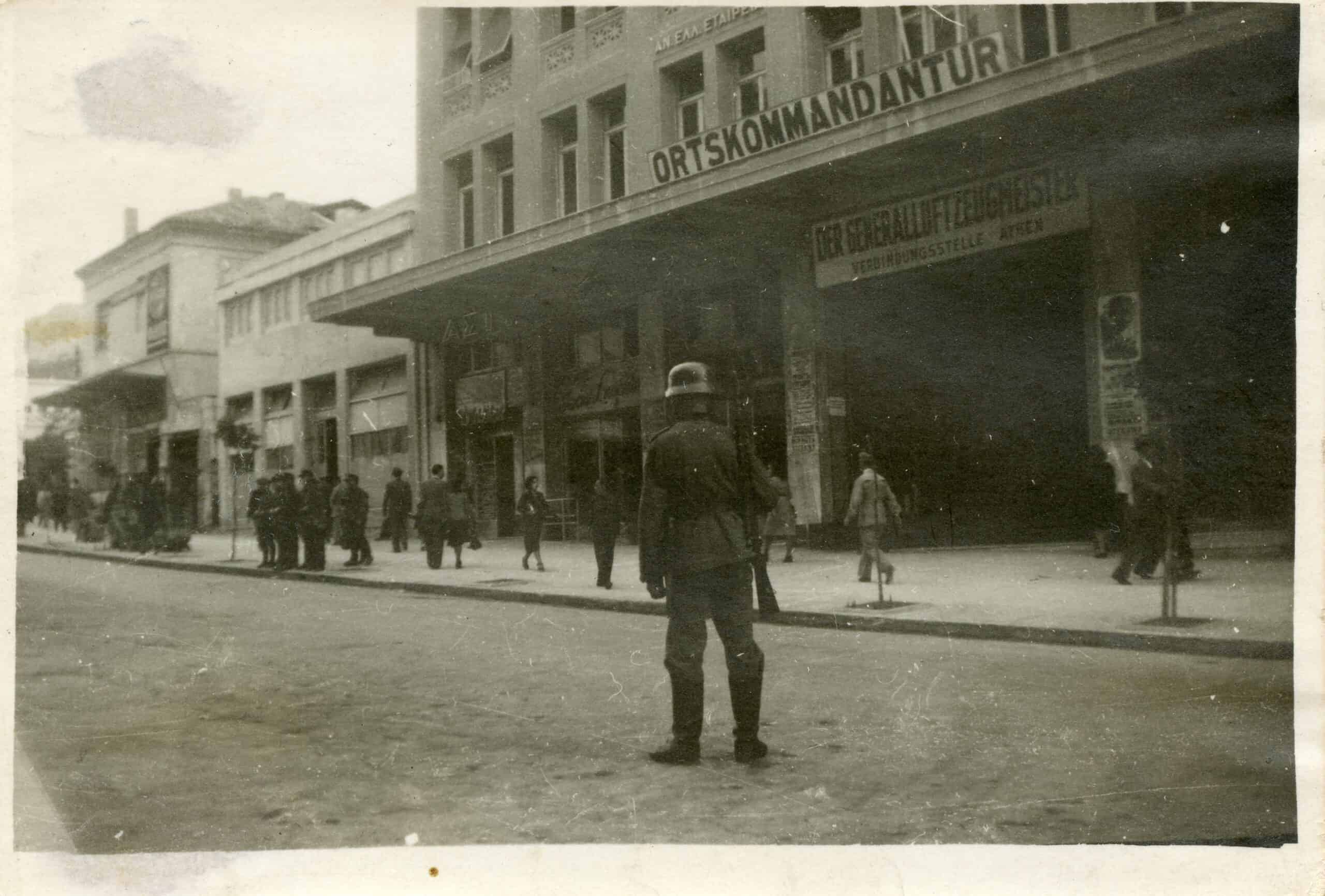
GERMAN CITY HEADQUARTERS, ATHENS

The German City Command Headquarters in Athens (Stadtkommandantur Athen) was the seat of the city’s administration, like all command headquarters in occupied cities in Europe. It was established in May 1941 in the National Insurance building at 4 Korai Street. The building had been completed in 1938 and was luxurious for its time. It had an elevator, central heating, and air-raid shelters with special doors fitted with rubber seals to prevent gas from entering the basements[1].   The German forces evacuated the building of its staff and removed furniture and desks, while converting the building’s air-raid shelters into detention cells, group rooms and individual cells.

The Guardhouse was the heart of the military administration of occupied Athens. The unit permanently stationed at 4 Korai Street was the 921st Military Police Unit (Feldgendarmerie), i.e. the German Military Police, which was formally responsible for maintaining order on the streets of the city and the authority to arrest civilians and German military personnel for any offence. In April 1944, the commander of the Guard was a certain Lieutenant Weiss, and the commander of Unit 921 was a certain Lieutenant Weber. At the same time, Unit 921 had a strength of 32 men (1 officer, 27 non-commissioned officers and 4 privates), while there were another 45 men (5 officers, 13 non-commissioned officers and 26 privates) as the permanent force of the Guard Headquarters, for a total of 82 men.[2] Based on photographic material depicting the building, it appears that it also housed the branch of an Air Force command (Generalluftzeugmeister – Verbindungsstelle Athen) and a military cinema (Soldatenkino).

The building was in continuous operation throughout the Occupation (May 1941-October 1944). The “kommandatura”, as it has been imprinted in people’s vocabulary and has survived to this day, was a key reference point in the topography of Athens during the Occupation, as well as a synonym for daily oppression. The appearance of the Military Police men struck terror into the hearts of citizens, who often associated them with the SS and the Gestapo, calling them “Gestapo petals” because of the characteristic kidney-shaped petals they wore around their necks. Thousands of people passed through the basement of the Guard Headquarters, including resistance fighters, demonstrators, and citizens who had been arrested for minor offences, such as violating the curfew. Many of those held at the Command were later transferred to other detention facilities, mainly the Averoff Prison. There is no estimate of the total number of people held there. In November 1943, the International Red Cross Relief Committee (IRRC) reported 100 prisoners and provided interesting information about their living conditions: “The Germans said that they could not prepare food for the prisoners of the Command, but if someone brought them cooked food, they had no objection to distributing it to the prisoners. The days go by and about 100 people are left with just a bit of bread and water as their only food.”[3] Polytechnic student Phoebus Tsekeris, who was arrested on 21 July 1943 in Pangrati and remained in custody for about two months, describes a suffocatingly crowded space and a life full of interrogations, torture and constant terror from the German guards. His description of the prisoner community is also interesting: “People are constantly coming and going in the Komandatura detention centre. People of all ages, from all social classes and various professions, from shoe shiners to university professors. Mostly resistance fighters. But also, pimps and hashish dealers, thieves, homosexuals, all mixed together […] But what mattered most was that all these criminals were not locked up there because of their crimes, but because they had harmed the Germans in some way […] One night I woke up and saw a sight that left me speechless. The entire corridor between the two rows of beds was filled with new arrivals, who were being carried in continuously. They all stood silently because there was no room for them to sit down.[4]

The walls of the underground detention cells were covered with graffiti written by the prisoners, who recorded their details as well as their thoughts and feelings in a few hastily written lines, such as “Mavromatakis executed in the basement”, “8.4.44. Accused of stealing tyres and bicycles from the Axis. Beaten by the soldiers. Oh, bah. And spend Easter in these chains, in this damp tomb”, “I want water”, “Halaris brothers. honourable citizens. They were unjustly detained by informers.” These inscriptions, which have been preserved to this day, are important and unique archaeological examples of the Nazi Occupation, evidence of “the destruction of the individual’s mental integrity, which became the norm during the Occupation.”[5]

The Command was dissolved on 28 September 1944, before the evacuation of Athens by German troops was completed.[6] The building returned to the ownership of the National Insurance Company and the basements were converted into archive storage rooms. On 31 January 1991, following an initiative by the National Insurance Company, the building was listed as a Historic Preserved Monument by the Central Council of Modern Monuments of the Ministry of Culture. During the maintenance works, important remnants of the occupation period were found, including handwritten notes, newspaper clippings, wrappings of everyday objects, metal objects, etc.[7] The inauguration of the space, which was named “Space of Historical Memory 1941-1944,” took place on 16 May 1991. From 1995 to 2008, the space remained closed due to construction work. Today, it is open to visitors and operates daily. 


[1] Anna Maria Droumbouki, “Koraes 4. A prison in the city centre,” in: Savvas Stroumbos (ed.), Franz Kafka, In the Penal Colony, Nefeli, Athens 2009, pp. 59-70, here p. 61.

[2] RH 34/263, Annex to Athens City Command, Tgb. No. 730/44 geh., List of troops present in Athens, 10 April 1944.

[3] ELIA-MIET, Aristotelis Koutsoumaris Archive, F. 52, subfile 2, Koutsoumaris, Note to Mr. Fischer, Athens, 2 November 1943.

[4] Foivos Tsekkeris, Here is the Polytechnic. During the years of the Occupation. From the struggles with the Student Union. Athens 2007, p. 101

[5] Droumbouki, Korai 4, pp. 65, 66.

[6] Eleftheria, 30 September 1944.

[7] Droumbouki, Korai 4, pp. 67, 68.