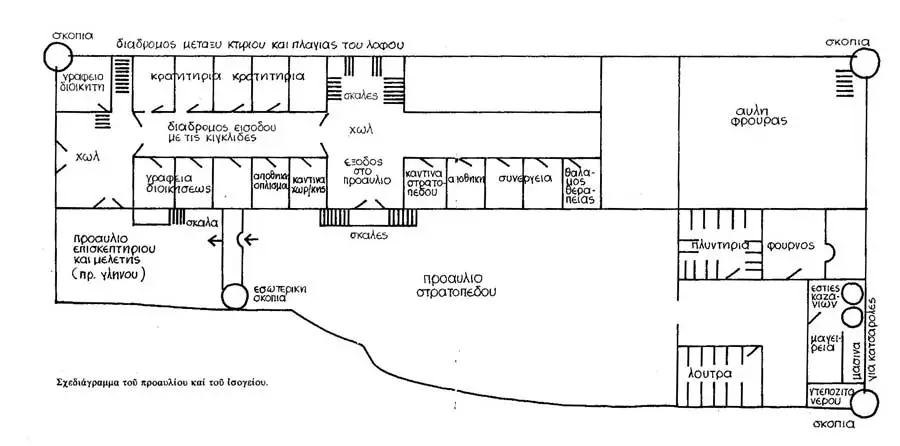
Akronafplia or Its Kale is a rocky peninsula approximately 900 metres long and 400 metres wide, located at the entrance of the Argolic Gulf. Since ancient times and throughout the Roman, Byzantine, Venetian and Ottoman periods, it served as the fortified citadel of Nafplio. From the 1830s, it was used as a military installation (camp, warehouses) and from 1884 for military and later penal prisons. In 1937, during the Metaxas dictatorship, the “Communist Concentration Camp” was established in the Akronafplia prison building, which was not under the jurisdiction of the Ministry of Justice like other prisons, but under the Deputy Ministry of National Security. Members of communist and Marxist organisations were sent to Akronafplia, including leading members of the Communist Party of Greece, and as a result, Akronafplia became the main place of detention for political prisoners, linked to various islands of exile for communists (Folegandros, Anafi, etc.), but also an example of the organisation of camp life, within the framework of which the so-called “Coexistence Groups” of prisoners were organised.[1] According to a report by the Ministry of Justice in 1945, when the prisons began operating again, “the building consisted of two large floors, with four large chambers and two smaller ones, which are used for the accommodation of prisoners. There are also smaller rooms on the first floor used as offices and for prison staff. There are also five small rooms for disciplinary purposes, completely lacking lighting and ventilation […] The large prisoner cells are 30 m long, 20 m wide and 5 m high, with 120-140 prisoners in each cell.[2]
When the country was occupied in April 1941, there were about 600 imprisoned communists there, who were handed over by the Greek authorities to the occupying forces. The camp continued to be under the jurisdiction of the Ministry of Public Security.[3] During the famine of winter 1941/42, three political prisoners and 32 criminals from neighbouring prisons lost their lives. From March 1942, mainly thanks to their own appeals and efforts, the imprisoned communists received regular supplies of food and medicine from the Red Cross Prisoners’ Office, while in the same year, it was agreed that prisoners with tuberculosis could be sent to sanatoriums. In June 1942, the Italians estimated the number of prisoners at 450.[4] At the same time, they demanded that they be transferred to another part of the country for the safety of the local guard in the event of an Allied landing.[5] The Greek authorities also requested that the building be handed over to them in order to relieve congestion in the prisons of Tripoli and Patras.[6] The transfers of communists began in September 1942 until the final evacuation of the camp at the end of February 1943. The prisoners were dispersed to other locations, to the camps in Larissa, Katouna-Xiromero and Trikala, to the Sanatorium Prison of “Sotiria”, to the Sanatorium of Asvestochori and to the Criminal Prisons of Corfu. In September 1943, approximately 350 of them were transferred to the Haidari camp. From the beginning of 1943, the communist prisoners who came from Akronafplia and had already been imprisoned for six years were a key source of hostages for the reprisals of the occupying forces. It is estimated that over 300 former prisoners of Akronafplia were executed during the Occupation in various camps where they had been transferred as hostages (Haidari, Pavlos Melas, Larissa). The climax was the mass execution of 200 prisoners from the Haidari camp on 1 May 1944 at the Kaisariani shooting range, among them 135 Akronafplians.[7] The connection of the communist prisoners with the occupation reprisals, but also their contacts with the Resistance, thanks to which a large number managed to escape from various places of confinement during the Occupation (Asvestochori, Sotiria, Corfu) made the title “Akronafpliotis” synonymous with militant sacrifice.
After 1945 and during the Civil War, Akronafplia began operating again as a prison for political prisoners and captured rebels, both men and women, and several executions took place. In 1966, the prison ceased to operate and the buildings were transferred to the Ministry of Tourism. In 1961, while the prison was still in operation, the Xenia Hotel was built in Akronafplia, but it ceased to operate in the late 1970s.
[1] Flountzis…
[2] GAK, Ministry of Justice Archive, f. 174b , subf. 12, Argolis Health Centre, Health Report on Akronafplia Criminal Prisons, 5.7.1945
[3] GAK, Ministry of Justice Archive, f. 174a , subfile 2, Greek State, Ministry of Justice/Directorate of Penitentiary Administration to the Metropolitan of Argolis, AP 6787, 24 February 1942.
[4] Paolo Fonzi, Fame di Guerra. L’ occupazione italiana della Grecia (1941-43), Carocci Editore, Rome 2019, p. 125.
[5] Stelios-Periklis Karavis, The Italian Occupation of Greece (1941-1943). The policy of enforcement and repression by the XI Army, doctoral thesis, Aristotle University of Thessaloniki, 2015, p. 49.
[6] GAK, Ministry of Justice Archive, f. 176, Public Prosecutor’s Office of Nafplio to the Directorate of Penitentiary Administration, AP 216, 19.1.1943.
[7] Kleon Papaloizos, National Solidarity-Folegandros-Ai Stratis, Athens 1977, p. 67.